
Oro-Medonte Forest School
Parent Handbook
Updated September 2024
Mission Statement
To build a community that fosters rich, experiential learning, age appropriate ecological literacy, and promotes healthy living by connecting children to nature through the use of the Forest School model in the foundational early years and beyond.
OMFS Vision
The OMFS Vision is to provide children with frequent opportunities to play and learn in local forests, meadows, wetlands and gardens with educators who understand the power of play and child-directed learning. Our hope is that children will develop a strong sense of self, a healthy connection to the land and community, and will recognize the importance of contributing to a more intersectional, sustainable world.
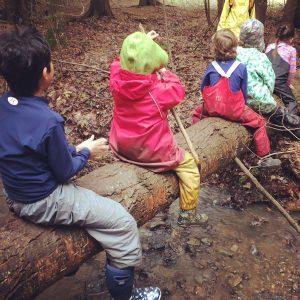
Table of Contents
1. General Information
1.1 What is Forest School
1.2 What is OMFS
1.3 Programs
1.4 Registration
1.5 Payment and Refund Policy
1.6 Program Location
1.7 Contact Information
2. OMFS Policies
2.1 Privacy
2.2 Illness Policy
2.3 Food and Allergy Policies
2.4 Toileting and Handwashing
2.5 Participant:Staff Ratios
2.6 Risk Management
2.7 Emergency Procedures
2.8 OMFS Responsibilities
2.9 Volunteer/ Accompanying Adult
Responsibilities
2.10 Parent Responsibilities
2.11 Preparing for Forest School
2.11.1 Sunscreen and Bug Spray
2.11.2 Clothing and Equipment
2.12 Child Protection Policy
2.13 Inclement Weather/Closure Policy
2.14 Extreme Weather Policy
3. Learning and Development
3.1 Behaviour Management Policy
4. Inclusion and Accessibility
4.1 Statement on Inclusivity
5. Communication Strategy
5.1 General communication
5.2 Emergency Communication
5.3 Questions and Concerns
5.4 Grievance Policy
6. Environmental Policies
6.1 Land and Environmental Ethics
6.2 Leave No Trace
COVID-19 Specific Policies will be sent to
families upon registration - please note that
these temporary policies may replace policies
written in this handbook. Components of the
handbook that may be replaced by Covid-19
Specific Policies are marked with an asterix (*).
1. General Information
1.1 What is Forest School?
The Forest School approach to learning originated in Scandinavia in the late 1950s and
has been widely adopted around the world. Oro Medonte Forest School (OMFS) applies
the guiding principles of Forest School Canada to promote learning and connect
children and their families to the natural world through experiential learning. OMFS
acknowledges our presence on Indigenous land and aims to build relationships with
Indigenous teachers who wish to visit, share and connect with the children in the
program. In the Forest School program, children spend anywhere from a half day to a
full day outdoors in meadows, forests, mountains, shorelines and natural spaces. Forest
School programming fosters children’s development through child based learning,
outdoor play, collaborative & independent inquiry and exploration in an outdoor setting.
Having time to regularly visit and learn in the same forested land is an excellent chance
for children to connect with nature, themselves and to build healthy relationships with
their peers. The Forest School program provides many benefits which include: helping
to build children’s self-awareness and confidence, communication skills, critical and
creative thought, physical and social skills, and the ability to navigate risk. It is
recognized that the Forest School approach to learning can have a significant impact on
the overall development of children.
For more information on Forest and Nature Schools in Canada please visit Forest
School Canada.
“All Forest School programs adhere to: regular and repeated access to a natural space,
as well as child-directed, emergent and inquiry-based learning. The defining feature of
this type of nature-based education program is that children are provided with
opportunities to build an on-going relationship with the land, to a dedicated educator, to
one another, and to themselves through this educational lens.” – Forest School Canada
1.2 What is Oro-Medonte Forest School (OMFS)?
OMFS offers children a space to connect to the land and to each other. While involved
in child-directed, emergent outdoor play, children gain confidence to face new
challenges. Various Forest School programs are offered to children between the ages
of 2 and 12 years old.
What OMFS IS and IS NOT -
OMFS is a recreational program that children may attend one or two days weekly.
OMFS is not an academic based program, the forest school program is a
supplement/compliment to a child’s home or school based academic learning. The
OMFS program does not follow a curriculum. If your child is not attending public
education, the responsibility for academic learning does not fall to OMFS. While
attending forest school the expectation is that a child is enrolled in academic learning or
has home based academic learning taking place.
Where We Learn -
OMFS programs run almost exclusively outdoors and use the natural environment for
exploratory play, no matter what the weather might be. OMFS educators help to prepare
children for the weather conditions and the children’s safety and enjoyment is the
number one priority. OMFS believes that learning and playing actively, in an outdoor
environment, will help future generations feel more comfortable in, and be more
connected to the natural world. While OMFS has some extra outdoor clothing, children
should arrive dressed for the weather each day (see section on Clothing). Although
there is access to an indoor area, it is generally only used briefly during the colder
months and in very inclement weather.
Why is Outdoor Learning Important?
Being outside in a natural environment has been shown to relieve stress by reducing
the stress hormone, cortisol, in the brain. Children are increasingly surrounded by
stressful situations and environments such as media, busy urban environments,
academic testing, screen time etc. and being able to learn outside gives them the time
needed to relax, enjoy themselves and be stress free. In addition, learning outside
helps children to build a personal connection with nature. Ideally, this personal
connection with nature will allow our future generations to understand and value the
natural world.
What happens on an ‘average’ day at Forest School?
The day’s activities at Forest School are free-flowing and dynamic, as they depend on
the ever-changing natural environment in which the program takes place (changing
seasons, evidence of animals, emergence of new flowers, insect activity, effects of
weather on the land etc.) and on the interpersonal relationships formed between the
children and educators in the group. Educators can also add to the day’s learning by
introducing provocations such as simple tools and loose parts used for building and
creating. Forest School educators follow the lead of the children, focusing on their
interests and questions of the day and allowing for independent play as well as
collaboration. We open and close each day in the gathering space where we may
incorporate literacy activities such as stories, poems, songs, plays, sharing, artwork and
music-making to expand on the children’s learning and discoveries. On an average day
we spend most of our time outdoors, rain or shine!
1.3 Program Location:
Program Location:
Oro-Medonte Forest School takes place on the traditional lands of the Huron Wendat
and the enduring lands of the Anishinaabeg, and this area is home to First Nation, Metis
and Inuit people from across Turtle Island. We play, explore, and learn on this land with
the recognition that we have a duty to recognize and honour Indigenous wisdom when it
comes to treating the land with care. When we gather here, we do so with respect for
the land, and all living things, while focusing on ways to build relationships with
Indigenous partners. We acknowledge that the Williams Treaties and Treaty 16 that
were broken on this land failed to recognize the relationship that Indigenous people
have with the land. We recognize ourselves as Treaty partners and we take time to refer
to the TRC Calls to Action #62 and #63, ensuring that we regularly share about the
incredible Indigenous contributions to the world, while also working to grow cultural
understanding and respect. We see and share about Indigenous excellence all around
us, noting artists, authors, musicians, teachers, leaders, and many more community
members, while aiming to hire, amplify, and uplift Indigenous people.
Our forest school location is adjacent to the Copeland Forest, a forest currently
managed by the Ministry of Natural Resources. This area expands 4400 acres across
rugged hills, swamps, forests, and watersheds. The Copeland Forest has a vast many
trails and is an incredible place to explore.
Sugar Valley Farm is on 38 acres and the beautiful Coldwater River flows through the
property, home to salmon who spawn here. The land is also dotted with a few lovely
ponds which are filled with life! A chorus of frogs can be heard singing in most places
around the property. The forest consists of hemlock, maple, birch, cedar and some
white pines. Fragile plant life such as lady slippers (a species of orchid) can be found
here, as well as the vast diversity of wildlife that calls this forest home. The trails that
travel through Sugar Valley Farm make for excellent forest school terrain with access to
a shallow area of the river, frog ponds, and open spaces of forest and meadow.
Directions
Please note - taking Line 5N directly off of Horseshoe Valley Rd. will take you on
an unmaintained dirt road.
From Orillia and area:
1. Take HWY 12 heading north out of town (towards Midland)
2. Turn left (heading west) onto Horseshoe Valley Rd.
3. Follow Horseshoe Valley Road until you reach Line 6N heading NORTH (past the
Sugarbush community) and turn right
4. Turn left (heading west) onto Ingram Rd off of Line 6N
5. Turn left (heading south) onto Line 5N off of Ingram Rd
6. Sugar Valley Farm is on the left just past the Copeland Forest P3 (small parking
lot)
From Barrie and area:
1. Take HWY 400 north and take the HWY 93 (Penatanguishine Rd.) exit (heading
south) towards Craighurst
2. Turn left shortly after this exit onto Ingram Rd.
3. Follow Ingram Rd. until you reach Line 5N and turn right
4. Sugar Valley Farm is on the left just past the Copeland Forest P3 (small parking
lot)
1.4 Programs
OMFS offers a variety of program options to suit your family’s hopes for forest
school programming!
Forest Explorers is available as a half or full day program designed for children aged
4-7, who are toilet trained and eager to explore the outdoors with our educators. Our
Forest Explorers gain much independence and comfort in the forest as they take part in
this once weekly program.
Forest Adventurers is designed for children ages 4-10. These young adventurers will
be comfortable being outside for a full day and must be at least kindergarten age to
enter the program. This program is currently available 2 days/week (Monday &
Thursday).
Forest Trekkers is a full day program suitable for children ages 6-12 who are eager
adventurers and comfortable both in the outdoors, and with a full day of programming.
Our entire day is spent in the forest, with the indoor space available for lunch in the
winter months and during significant inclement weather in the other seasons.
Forest Friday is a caregiver & tot program most beneficial for children ages 2-4, though
some slightly younger and older participants have enjoyed and thrived participating as
well. Parents and children explore together, while our educators take part in carving out
a wonderful, child directed environment. The Forest Friday program takes place in
pre-registered sessions on Friday mornings, however, drop in is generally available
weekly!
To register for one of the above programs, please visit the Registration page for
dates and registration forms. Oro-Medonte Forest School - Forest School Programs
1.5 Registration
Registration will open for the next session at least 2 months in advance. Returning
families will be given at least 2 weeks notice to re-register for the next session, prior to
opening registration to the public, this includes families switching between our various
programs.
Registration will be conducted on our website and on a first come, first served basis, as
such it is recommended to include a first and second choice for the program you wish
your child to attend. Families will be reached by email to confirm their registration and
will be requested to make a deposit payment (or make their payment in full if that is their
preference).
Please note that while OMFS makes every effort to place a child in the preferred
program, this cannot be guaranteed. Children are placed on specific days of the week
based on age, experience and other factors determined by the OMFS Director.
Summer Camp registration will open in late January or early February each year.
Please check the OMFS website and social media pages for details.
1.6 Payment, Invoicing and Refund Policy -
If you are paying monthly, payment is expected within the first week of each
month. Payments are considered overdue if they are made following the 5th
of the month. A 5% administrative surcharge will be applied for any
outstanding fees. These fees will be reflected on the next invoice.
Payments may be made by e transfer to [email protected] using your
child’s first name as the passphrase (do not use nicknames); cash and cheque
payments must be in an envelope labelled with the following: Child’s Name, Invoice #,
Amount and Date.
Summer Camp payment will be invoiced after your child’s registration is accepted.
Payment is due within 7 days of registration acceptance.
If you wish to withdraw your child during the year, we require 60 days notice. Withdrawals are only accepted at the end of the month. Any fees due within this 60 day time frame are still
required to be paid in full and are not refundable. OMFS can terminate program arrangements immediately (at any time during the year) for any of the following reasons (but not solely limited to):
- Failure to comply with policies
- Persistent destructive or hurtful behavior, bullying from the child after multiple attempts to support and collaborate with the family
- Non-Payment of fees or late and/or recurring late payment of fees
OMFS does not offer refunds for illness or weather cancellations.
OMFS Forest Camp: If you must cancel your child’s participation in one of our
Forest Camp programs the following refund policy will apply:
● 30 or more days notice: FULL REFUND minus a $25 admin fee
● 14-29 days notice: 50% REFUND
● Less than 14 days notice: NO REFUND AVAILABLE
1.7 Contact Us
Email: [email protected]
Phone: 416-459-5461
Emails and phone messages will be responded to within 24-72 hours on business days.
Messages received on weekends may not be answered until Monday. Messages on
holidays will be responded to upon reopening. If you do not receive a timely response,
please resend your message as it may have been deleted due to sensitive spam filters.
Mailing address (this is NOT our school location):
Oro Medonte Forest School
134 Isabella Drive, Orillia ON L3V 8K7
2. OMFS Policies
2.1 Privacy
Oro Medonte Forest School respects the privacy of the children registered with us and
we have taken steps to protect it. Personal data shared with us, including photographic
images, will be processed strictly in accordance with privacy legislation, and will be
used only for the purposes that you have consented to. OMFS will not share details with
third parties without consent, except where we are legally or obligated to do so. Upon
registration you will be asked to sign a media release consent form. Photos will only be
shared with this given consent and for the purposes agreed upon (ie. social media
updates, website pages, program promotion). Please note that where consent is given
to share images on the internet, they can be viewed worldwide including countries
where Canadian data protection law does not apply.
2.2 Illness Policy
In order to ensure the health of our community, OMFS participants are asked to stay
home from our program if they have experienced any of the following symptoms in the
past 48 hours:
● Fever
● Vomiting
● Diarrhea
● Significant, unexplained rashes
● Significant cough
● General lethargy
In the case where one of the above illnesses occurs during the Forest School day, the
affected participants will be required to return home. Keeping in mind that, while
experiencing these symptoms or even more mild cold symptoms, being outside in the
elements is likely quite uncomfortable and unpleasant for children. Phone calls to
parents/guardians and/or emergency contacts will be made so that the child can be
picked up.
Any participants affected by a communicable disease (such as measles, chickenpox,
mumps, whooping cough, strep throat, influenza, pneumonia, covid etc) are asked to
stay home from forest school until their health care provider has communicated that it is
safe for them to rejoin public programming.
Please note that there are no refunds or make up classes for missed days due to
illness.
2.3 Food and Allergy Policies
OMFS strives to keep all children safe by implementing the following food policy. If your
child has a food allergy, ensure that you include the details of this on your registration
form. Children with life threatening allergies will be required to carry an Epi-pen on their
body at all times. Please also provide one for the Lead Educator to carry as a backup.
Please refer to our Health/Registration Form for details on this requirement.
All children are required to bring their own food and water to the OMFS program.
There is a strict policy that children do not share food due to hygiene and allergies in
groups. Food is to be kept in reusable containers which can be easily stored in a child’s
backpack or pockets as groups have snacks while out in the forest. In an effort to
generate minimal waste, please make an attempt to provide a snack for your child that
does not contain any packaging or garbage, all garbage will be sent home in your
child’s lunch containers. If your child’s snack requires a utensil, please ensure that this
is sent as educators do not have utensils available while out in the forest. Children
should bring healthy snacks that will give them the energy needed for the program.
Please note that OMFS is a Peanut Free Community.
Please avoid sending peanuts in your child’s snack/lunch at all times.
On occasion educators will provide the children with herbal tea and fresh, dried
or cooked fruit/vegetables. In addition, groups may do some campfire cooking.
Please note on the child’s registration form if they have any food allergies or
intolerances.
Please touch base with your child regularly about their snacks and how they are
working out for them. Too much/too little; too messy; too squishy are all concerns that
you might run into with snacks in the outdoor environment. Example: Please do not
send unpeeled oranges or clementines with your child if they are unable to peel
them independently.
Water: Please ensure your child has a full water bottle each time we meet. Please
ensure this water bottle is leak-proof and has a large enough capacity to keep your child
hydrated (OMFS recommends 500ml for all children attending a full day), though is
going to be light enough to carry in their backpack. Educators will carry extra water and
we have a refill station for water at the Cedar Grove gathering place.
A Special Note about Food Allergies:
There are children in OMFS programs who have significant allergies, not all life
threatening. For this reason, educators teach the children to eat while being mindful of
their peers. If your child has an allergy that can be impacted by crumbs, touching others
who have eaten a specific food, or by smell, please be certain to inform OMFS of this on
your child’s registration form. Educators will make every effort possible to ensure their
safety.
2.4 Toileting and Handwashing
OMFS requires that all participants are fully toilet trained prior to starting drop off
programs. **This does not include Forest Families**
If your child has an accident, educators will happily assist them in changing into their
spare clothing. However, OMFS cannot accept children into the drop off programs who
are using diapers. Please ensure that your child is independently using a toilet prior to
the start of the session. **Exceptions to this rule may be that a parent chooses to
(temporarily) remain on site with their child to support their toilet training effort.
The washroom facilities at Sugar Valley Farm are composting toilets and outhouses.
The facilities are all outdoors, however the composting toilet is located directly beside
an indoor shelter used for forest school.
Children must be comfortable using the “washroom” outdoors, with minimal “coaching”
from an educator. All educators will carry appropriate toileting and hand washing tools
such as toilet paper, wipes, hand sanitizer, water and soap.
Educators will provide children with hand washing opportunities before and after meals
and after washroom breaks whether indoors or in the forest. The educators will carry
water and hand soap and hand sanitizer for this purpose on each outing. Please send
your child with a small hand towel for drying their hands, to be kept in their backpack
each day.
2.5 Participant:Staff Ratios
OMFS will maintain a ratio of 6 children : 1 educator depending on the age and
experience of the groups. If either the parents or educators feel that a child requires
additional support, they may request a meeting to prepare an appropriate plan, noting
that OMFS does not provide one on one support for children. These small ratios are
important to the success of the program, the safety of the children, and the ability to
facilitate the child-led learning approach in an outdoor environment.
In the case that the ratios cannot be maintained for an unanticipated reason (illness,
first aid emergency etc) the group will remain at the Cedar Grove next to the chalet or
head indoors until the ratios have returned to normal.
2.6 Risk Management
OMFS educators will aim to balance children’s desire to experience and navigate risk in
the natural environment with a concrete safety plan that has clear boundaries,
emergency procedures and by maintaining the above mentioned child to adult ratio.
Being able to recognize risk, experience risk and learn how to manage risk is an
important part of healthy child development. Therefore, in many instances, OMFS
educators will strive to co-assess risk with the students and work together to formulate a
plan to manage it.
Some of the risks inherent to Forest School and outdoor play in general include, but are
not limited to: (please see Informed consent form for a more detailed list of inherent
risks)
● Injuries from executing strenuous and demanding physical activities, possibly on
uneven ground in the forest
● Slivers, scrapes, bruises, blisters
● Injuries resulting from matches or fire
● Contracting poison ivy
● The presence of wild animals and ticks
● Presence of hunters in the Copeland Forest**
**Hunting in the Copeland Forest does occur at intervals throughout the year.
OMFS works to mitigate this risk by the following:
● Avoid going into the Copeland Forest during hunting season
● Add brightly coloured clothing to any child in dark outerwear during hunting
season when groups may be playing in or near the boundaries of the Copeland
Forest
● Travel in large groups so that noise may alert hunters of the group's presence.
2.7 Emergency Procedures and First Aid -
OMFS has written emergency plans and procedures in place. All educators are familiar
with the plans and review them on an annual basis.
Each group will carry an emergency bag at all times. The emergency bag will contain
an emergency contact list and a regularly stocked first aid kit. The emergency bag is
equipped with various sizes of bandages, splints, antiseptic wipes, eye wash,
anti-allergy medication, and hypothermia blanket. Each of the OMFS educators will
carry appropriate communication devices, a whistle and a first aid kit at all times.
Each parent must ensure that the Forest School educators have current emergency
contact information. OMFS educators carry this information in a waterproof bag with
them at all times to ensure that, in the case of an emergency, the appropriate contact
can be reached. OMFS educators will carry a cell phone at all times to contact
parents/guardians and/or EMS if required.
OMFS educators will all maintain the following certifications (at a minimum):
● Current Criminal Record Check with a vulnerable sector check
● Current Standard First Aid/CPR or greater (ie. Wilderness First Aid)
2.8 OMFS Responsibilities
● OMFS will ensure the physical and emotional safety of all participants, volunteers
and staff by co-assessing and co-managing risk, on an ongoing basis, so that all
participants feel comfortable and can learn effectively in their surroundings.
● OMFS educators will model care and respect for others, our shared community,
and for the natural world.
● OMFS educators will aim to connect with each student in order to understand
their questions and interests and will provide regular and repeated access to a
natural outdoor space, so that they may build strong relationships with
themselves, each other and the land.
● OMFS will ensure parents are aware of any changes or adaptations to
programming or policies and will update all families on a regular basis with such
changes.
● OMFS will ensure all educators, supply teachers and volunteers have a recent
Vulnerable Sector Criminal Reference Check and Standard First Aid/CPR current
certification on file.
The educator’s role varies from a traditional classroom teacher in that OMFS educators
are not the “experts”, but simply a guide for the child’s learning. They seek to learn
alongside the children with prompting questions and deepening conversation about the
natural world. OMFS educators help students construct knowledge about themselves
and their world by introducing tools or supplies that can modify the learning environment
and bring forth growth in the learner. They view unstructured free play as the primary
vehicle for learning. Forest School is a place where play and “doing” can help children
make meaning in their environment. For example, a child at Forest School may use
objects found in nature to take the place of a conventional toy, find challenges in moving
fallen tree branches to build a structure or discover patterns in the way water moves.
OMFS educators will help a child to see these possibilities and then let their play and
imaginations take off!
2.9 Volunteer/ Accompanying Adult Responsibilities
We welcome and value the support of volunteers at OMFS. Volunteers will need to
acquire a Current Criminal Record Check with a vulnerable sector check before
helping out. We encourage volunteers to become familiar with the Forest School
Program and the role of Educators in guiding learning. Volunteers will be responsible
for helping to monitor and will be available to support children during the program.
2.10 Parent Responsibilities
By registering your child for Forest School at OMFS you agree to the following
responsibilities:
Submit all forms and applicable fees prior to your child’s session of forest school. If forms are not received, children will not be permitted to attend until which time they have been filled out and reviewed by OMFS.
Ensure your child is equipped with proper clothing, outerwear, food and other supplies suitable for the season and duration of the day (please see Clothing and Equipment). Groups are basically outside all day, in all types of weather. If a child does not come properly prepared for a day of Forest School they will be asked to return home and change and arrange to meet the group in the forest.
Communicate openly with educators and provide us with any information that will assist us in meeting your child’s needs. Share any changes pertaining to contact information, health or wellness needs asap.
Follow all policies and guidelines outlined here in the parent handbook.
ENSURE ALL ITEMS SENT TO FOREST SCHOOL ARE CLEARLY LABELLED.
2.11 Preparing for Forest School
The following is an important component of taking part in OMFS programs. All children
are required to have appropriate gear to participate in forest school programs. Please
read carefully and ask questions as needed.
2.11.1 Sunscreen and Bug Spray
Please send labelled sunscreen and bug spray with your child during the spring,
summer and fall. If you do not wish for your child to use sunscreen we will require that
they wear a long sleeve shirt while in full sun. Bug head nets or jackets are
recommended when bug spray is not used, especially during the spring season when
black flies and mosquitos can be quite numerous in the forest!
2.11.2 Clothing and Equipment
All gear sent to Forest School MUST be clearly labelled!
OMFS is not responsible for lost or missing gear and will place all found gear into the
Lost and Found which will be emptied and donated where possible seasonally. Please
check regularly.
Each child, regardless of season, will require a small, well fitting backpack. Children will
often carry this pack with them on walks into the forest. They will carry their water,
snack, a small hand towel, dry socks and/or mittens and any layers that they remove or
put on as we go. Please ensure that this pack fits your child properly and that they can
carry it with ease. It is suggested that you do a trial walk with their pack to ensure that
they are comfortable.
Children MUST have a full water bottle in their backpacks each morning.
During the Spring and Fall, OMFS requires that children wear WATERPROOF rain gear
when accessing shallow bodies of water (such as the creek). Waterproof gear is
equipped with heat taped seams to prevent water absorption. Nylon material is not
waterproof and while it is quick drying, this will not keep their base and/or mid layers dry.
Please check with the Lead Educators if you are uncertain if your child’s gear is
waterproof.
Of key importance is the material of your child’s clothing. Cotton is not an acceptable
material for outdoor adventures in most temperatures, as it dries slowly and can
cause your child to be chilled when wet. Where possible, please choose synthetic,
wool or silk clothing which breathes well, dries quickly and insulates against the
elements.
Children will need a change of clothes to be brought to Forest School each day. This
does not need to be carried in their pack, but is left with our supplies at Cedar Grove.
Please ensure that the change of clothing is suitable for the season and is kept in a bag
marked clearly with their name.
**OMFS Summer Camp participants will be emailing a packing list prior to the program
start date.
The following are the OMFS recommendations of how to dress your child for the
elements. As the weather often changes throughout the day and as it is often cooler and
damper in the forest than in town, please use the layering system described:
If sourcing appropriate gear is an issue, please do not hesitate to let OMFS know
as we often know of great deals, ideal choices and used options.
Remember that it is often a few degrees cooler in the shade of the
forest than it may be at your home. Please dress with this in mind!
2.11.3 Seasonal Layering Systems for Forest School
Cool Rainy Day Clothing (Fall/Winter/Spring):
Base Layer: Synthetic or wool long john shirt and pants; wool socks
Mid Layer: Fleece or wool sweater and pants
Outer Layer: Durable, WATERPROOF raincoat and rain-pants; warm toque;
waterproof, insulated mittens; waterproof boots (Bogs, Kamik or similar)
Extra Layers: 1-2 pairs of wool socks, 1-2 pairs of waterproof insulated mittens;
warm toque; mid layer as indicated above; underwear.
Optional: Extra boots
Cool Dry Day Clothing (Fall/Spring):
Base Layer: Synthetic or wool long john shirt and pants; wool socks
Mid Layer: Lightweight fleece or wool pants and sweater
Outer Layer: Warm jacket; durable rain-pants, waterproof boots, waterproof
mittens; warm toque
Extra Layers: 1-2 pairs of wool socks, 1 pair of waterproof insulated mittens; mid
layer as indicated above; underwear.
Warm Rainy Day Clothing (Fall/Spring):
Base Layer: Lightweight, synthetic material t-shirt and long sleeve; lightweight,
synthetic material pants (quick-dry material is ideal); wool socks
Outer Layer: Durable, WATERPROOF raincoat and rain-pants; waterproof boots
Extra Layers: Fleece Sweater; wool socks, toque
Optional: Extra boots
Warm Dry Day Clothing (Fall/Spring):
Base Layer: Lightweight, long pants that can easily be rolled up; t-shirt;
lightweight synthetic socks
Outer Layer: Fleece sweater or jacket; closed toe running shoes or hiking boots; sun hat
Extra Layers: Extra socks; base layer
Optional: Bug jacket/headnet (Spring)
Cold Winter Day Clothing:
Base layer: Wool or synthetic long john shirt & pants; wool socks
Mid layer: Wool or fleece sweater and pants; fleece or wool neckwarmer
Outer Layer: Warm, waterproof, windproof and breathable snow suit; warm
toque; waterproof insulated mittens; warm waterproof boots
Extra layers: 1-2 pairs of wool socks; warm toque; mid layer, 1-2 pairs of
insulated mittens
Optional: Extra boots, hand-warmers, extra snowsuit
No Toys Please!
Please avoid bringing toys from home to OMFS. Toys present a problem in getting lost,
not being shared and they tend to influence the children’s outdoor play. If, however, a
child has a tool they would like to bring to share with the group this may be
accommodated.
*OMFS will provide sleds and ask that families not send them from home.
2.12 Inclement Weather/Closure Policy
OMFS will consider the SCDSB snow day criteria. If the buses are cancelled for the
NORTH or CENTRAL ZONE, there is a good chance that our programming will not run
that day. That said, the Director will post to all families via SeeSaw, typically, prior to
7:30 am, to notify of our closure for the day. In these circumstances, the closure is likely
due to the road conditions around Horseshoe Valley and surrounding area, or due to
extreme cold.
In very rare situations OMFS may opt to close due to severe cold as running
programming outdoors in such weather may pose a risk to the safety of both children
and staff.
In the event that OMFS is required, due to severe weather, to close early for the day,
our decision will be communicated to families via the number that we have on record to
reach you during our programming.
Please note that there are NO REFUNDS available for OMFS closure due to
weather.
2.13 Extreme Weather Policy -
The educators at OMFS pay close attention to the weather forecast and include weather
considerations in our safety assessment throughout the day. There are days where
groups will stay close to shelter due to high chances of thunder/lightning or high winds.
This close proximity will allow the group to quickly take shelter.
Outside temperatures that include extreme cold, -25C or below, or extreme heat, 30C or
above, will prompt educators to employ measures to ensure the children’s safety.
Educators will limit the children’s length of exposure based on age and outerwear, and
will constantly assess the group’s comfort and safety, watching for both cold and heat
related conditions. OMFS will use indoor facilities when required in these instances.
When significant weather warrants that OMFS runs programming indoors or under
shelter, educators will continually assess the outdoor environment for safety and return
only once they are certain the inclement weather has passed.
All OMFS programs will be cancelled or ended early if Tornado Watches or Warnings
are put in place by Environment Canada.
2.14 Program Pickup & Drop Off
If your child is going to be absent, please text 416-459-5461 (Mel) or email
([email protected]) the school BEFORE 8:30am. Knowing the number
of children expected each day is essential.
Forest School programs commence at 9:30am each morning at our gathering place, the
Maple Meeting Place at the picnic tables. Please drop your child off between
9:25-9:30am to ensure that all children are on site at the start of the program. Please do
not come any earlier as we will be busy with our preparations for the day.
Please plan to be here on time for your child’s pick up time (12:00pm for half day and
3:00 or 3:30pm for full day).
Late Pick Ups:
OMFS does not provide after hours care. Educators meet daily after programming to
reflect and plan for the next week. While a child will never be left unattended, late pick
ups and drop offs are both stressful for the children and difficult for program
operations. If extenuating circumstances arise and you are going to be late with either
drop off or pick up, please ensure that you have notified an OMFS Lead Educator via
text or phone call. Please make every effort to be on time each day.
3. Program, Learning & Development
Forest School Programming is inquiry based and driven by the childrens’ interests and
needs. This creates an atmosphere of relevant and meaningful learning for the
children. Educators extend this child led learning by providing provocations based on
seasonal cycles, what children have discovered or are curious/have questions about.
Planning takes into account weather, site conditions and social dynamics. Educators
observe the children's interactions and activities throughout the day and when
appropriate, document activities mentally or with photos. With this information,
educators meet at the end of the day to reflect on the day, noting areas of concern,
interests, growth and use this information to plan future activities.
3.1 Program Management -
Children may adventure to the forest in smaller groups or as one large group. This
decision is made by Lead Educators at the beginning of each day or session and the
decision is based on a number of factors: environmental impact, group management,
social dynamics, programming needs etc. OMFS may choose to organize this on a
more permanent basis or will do this as needed depending upon the specific group
needs. Adventure groups or animal groups are formed by Lead Educators with Educator
input and while OMFS appreciates feedback from parents, ultimately this decision lies in
the hands of OMFS staff.
3.2 Peaceful Play and Gentle Discipline
The OMFS community is the most important asset at Forest School. As a community,
educators will help the children to work together, to respect one another and to value
the ideas of others. As a group, educators and children alike will work through any
challenges that arise, ensuring that children’s concerns are heard and their feelings are
validated. OMFS promotes peaceful play whereby the children are encouraged to
speak to one another with kindness, compassion and empathy, building leadership skills
and a sense of self-worth.
OMFS educators prioritize gentle discipline practices, working with the principles of
redirection, validation of the children’s feelings and work to create an empathetic
environment. Whenever possible, educators encourage discussion of any differences,
so that the children can work on communicating their needs to each other and/or to an
educator or volunteer.
OMFS educators make every effort to do the following when challenging interactions
occur:
● Be proactive and observant. Take note of the social interactions between the
children.
● Remain physically close to a child or children if concerned about a social or
safety situation.
● Remind the children to use kind and respectful words to ask for what they need.
● Remind the children that hands are for working and playing, not hitting.
● Redirect the children to different activities or have them speak with an educator
or volunteer who will help them calm down.
● When the children are calm, discuss the situation with the children involved.
Encourage discussion of any differences so that the children can work on
communicating their needs to each other.
● Acknowledge children’s feelings and encourage them to express their
feelings about a situation using “I statements”.
● Encourage the child(ren) to consider alternative actions that they could
take in the future and provide immediate positive feedback when they choose
these alternative actions on their own.
3.3 Behaviour Management Policy -
In general, if a significant unsafe or inappropriate behaviour does take place the
following steps will be taken:
3 Step Plan:
1. Child will be taken aside from the group and spoken to about their behaviour and
the educator and the child will create a plan to understand and modify the
behaviour. Parents will be notified of the situation that occurred by phone/email
or an in person discussion, beginning the communication between parents and
OMFS.
2. Parents/guardians and OMFS will create a plan for the child with the goal to
modify the unsafe or inappropriate behaviour. Educators will work with
parents/guardians to determine the potential cause of the behaviour and develop
strategies to adjust the behaviour. Parents/guardians and educators will look to
create a consistent expectation and approach. This will be done via phone or
email. Educators and parents will stay in touch to keep informed about the child’s
progress with regards to this situation.
3. A meeting will be undertaken between the OMFS director/lead educators; the
child and the parents with the goal of changing the unsafe or inappropriate
behaviour. The OMFS director/lead educators will convey the message that if the
behaviour is unchanged after a period of time designated in the plan, that forest
school may not be an option for the child at that time.
***OMFS Educators will confer with one another to ensure consistent expectations and
approaches for that individual.
In extreme cases where a child’s behaviour is consistently inappropriate or unsafe for
the child, or for others, and after the above process has been implemented, the child
may be required to have a support person in place, or to temporarily leave the program.
Though, every effort will be made to ensure that all children will find their place in our
Forest School community.
3.4 Balance of Risky Play and Safety Ethics -
With hopes that each child will learn how to navigate risk, the OMFS goal is not to keep
children from all risky situations, but is instead to teach children how to safely navigate
the risks that they encounter in the forest. In order to do this, it is required that children
are able to respond to educators' voices (or animal calls!!) at all times. If a child has
consistent difficulty listening, and it is posing a safety concern, the behaviour
guidelines listed above will apply.
OMFS works to create an environment that is as safe as possible by being proactive
and by using sensible, simple guidelines that the children (and adults) can remember.
Our safety principles include:
Constantly assess risk as conditions change (dynamic risk assessment) and conduct regular risk/benefits assessments of site and activities.
Done daily and dynamically as the environment changes both with and without the children.
Set up a safe space with boundaries and safety guidelines.
Children respond to a crow call to stay within view of the educators at all times.
Children are made aware of safety guidelines regularly.
Carefully observe the children’s interactions with each other and with nature.
Spot the children during more challenging physical activity ex. climbing.
Gently guide the children to safer activities if required.
If OMFS educators observe that the children’s play is becoming dangerous and/or not
following the OMFS safety guidelines, the children will be redirected and reminded of
the safety guidelines established as a group.
The following guidelines and phrases are examples that educators will use with the
children as they are guided toward safe choices in our natural playground.
Hiking: When we walk through the forest, we are in a sandwich. One educator
will be in the front and an educator or volunteer will be in the back. The children
may not need to be in a line, but they do need to be inside the sandwich.
Boundaries: When we play in the forest we stay where we can see a teacher.
When needed, boundaries are established with the input of the children.
Educators watch to ensure that the children do not move beyond the boundaries.
Educators remain in close proximity to the children at all times. If groups are
working in different areas, there is an educator available for each small group. A
child is within the ”boundaries” if they can easily see an educator and an
educator can see them.
Sticks: Sticks are for building, digging, and imaginative play. They are not for
hitting. When we run, we put the sticks down. We are aware of other’s space. We
keep sticks away from others' faces. Children are taught to keep sticks down low
when in a group and how to create a “safety bubble” when on their own.
Rocks: When we are near the water, we may throw rocks. When we throw rocks,
we look around and check to make sure that no one is close to us, in our safety
bubble (the area a few meters around our body). We may throw rocks that are as
large as the palms of our hands. We throw rocks only where they won’t disturb
others (animals, birds, people). Children love to throw natural objects and they
will be given the safety parameters on how to do this.
Climbing: We may climb as high as we are tall. We only climb as high as we can
climb on our own. We only climb when an adult can safely spot us (watch us and
keep us safe). Educators are present only to spot a child and will not physically
assist them to climb higher. If an educator can’t be present or cannot safely spot
the child, the child will not be able to climb.
Water: If you don’t know, don’t go! Groups primarily access shallow, slow-moving
water bodies. Before a group visits a body of water, educators engage in a
conversation with the children about safety considerations while around the
water. If a child cannot determine the depth of the water to be below their knee
height, they generally will not access that water. Children are taught to maintain
at least 1 full adult body length of distance between themselves and deeper
areas of water. When hiking along the trails, children will be taught to stay on the
trails as the edges of the river and ponds are changeable where plant life is
growing.
4. Inclusivity/Accessibility -
4.1 Inclusivity and Accessibility Statement
OMFS strives to create a program which is accessible to a wide range of participants,
regardless of race, religion, gender, sexual orientation, language, physical ability, or
socioeconomic status. OMFS aims to create a community that is safe, inclusive and
welcoming to all participants. OMFS works to provide and source “subsidies” for families
who may not otherwise be able to participate. OMFS strives to promote an environment
that is physically accessible for all participants. In addition, the organization offers an
online gear swap of outdoor clothing to ensure that participation in OMFS is not limited
by lack of access to appropriate gear.
All children and their families are welcome in the OMFS community where everyone is
respected and appreciated as valued members. We encourage feedback to learn how
we can improve our programs by working towards removing barriers and ensuring a
safe and welcoming place in the forest.
5. Communication Strategy
5.1 General Communication
OMFS maintains the belief that communication with families is of vital importance and
benefits the children best. Please refer to your child’s Seesaw page for current
information about what the children have been up to at Forest School during the week
and how you can deepen/support their experiences at home.
OMFS Educators may be available to give a brief overview of your child’s day at pick
up, upon request. The Director and/or Lead Educators are also available, upon request,
for Parent Meetings to communicate about your child’s interests, current learning,
friendships and to answer any questions you have. Please contact OMFS if you would
like to arrange for a parent meeting. In addition, the OMFS Seesaw page offers a
secure online parent communication forum where we can communicate with you directly
about your child’s time at Forest School and share photos/creations etc.
OMFS Forest Camp families can expect communication via email rather than Seesaw.
5.2 Emergency Communication
In the case of a significant incident (eg. eye scratch/particles in eye, wounds,
bleeding, potential fracture, suspected head injury), Emergency protocol will be
followed and parents will be contacted before EMS and asked if they would like OMFS
to call or if they would like to take their child to the hospital themselves.
In case of a severe incident (major trauma and the child cannot be moved),
Emergency protocol will be followed and EMS will be contacted and parents will be
notified as well of the situation.
Parents must ensure that the Emergency Contact information given to OMFS remains
current at all times. If a change occurs, please email [email protected]
with the subject: Contact Information Change.
5.3 Questions and Concerns
OMFS welcomes your questions! If you ever have a question or concern about your
child’s learning, their experiences or their place in the Oro Medonte Forest School
community, please email the Directors Mel / Braden at [email protected]
All questions will be answered in a timely manner, within 24-72 hours. If your inquiry is
more urgent, please say URGENT in the subject heading and the Director will respond
ASAP. If you would like her to respond to you by phone, please let her know the best
number to reach you at.
If you would like to meet with us to discuss your child’s needs, this can be arranged by
sending an email indicating your availability.
The Director or Lead Educators may be available for brief conversations following the
program each day. If your questions pertain to more than they are able to answer at the
moment they will direct you to email and set up a call or meeting.
5.4 Grievance Policy
OMFS is always open to your concerns, questions and feedback. Growth is important to
this organization and it is through this communication that OMFS will continue to grow
and build relationships with our community. If you have a concern, please let us know
by email, phone or in person and we will be back in touch within 24-72 hours. If your
concern is urgent, please indicate this and a response will be prioritized. All concerns
will come directly to the Director and consultation with Educators will be a part of the
next steps to finding a suitable resolution.
6. Environmental Policies
6.1 Land and Environmental Ethics -
At OMFS, educators aim to model and teach the children how to respect the land. The
belief is that our youth will play a vital role in the protection of our Earth and its
resources in future years. The first step in this important learning process is for youth to
be given the opportunity to spend time in nature and to build their own relationship with
the natural world. During daily programs, the children will learn about and practice
environmental ethics in the forest, respecting the land they use and travel through.
6.2 Leave No Trace Principles
OMFS uses and teaches the LNT principles to guide our time spent in the forest
whenever possible.
● Plan ahead and prepare
● Travel on durable surfaces.
● Dispose of waste properly
● Leave what you find
● Minimize campfire impacts
● Respect wildlife
● Be considerate of other visitors
“If we want children to flourish, to become truly empowered, we must allow them to fall
in love with the earth before we ask them to save her.” (David Sobel)
Our Mission
Oro Medonte Forest School’s mission is to create an educational community that fosters rich, experiential learning, age appropriate ecological literacy, and promotes healthy living by connecting children to nature through the use of the Forest School model in the foundational early years.
Get OMFS Updates
For registration reminders and seasonal Forest School updates, please subscribe to our newsletter.


Copyright 2026 Oro Medonte Forest School